Strength training for fighters is different from a normal gym routine because the goal isn't to look bigger or lift the most weight. It's to be strong, fast and still able to perform when you're exhausted. That means more explosive work, more full-body movements, more conditioning, and less isolated "muscle" work, all planned so it supports your fight training instead of draining it.
Here's what actually changes, and how to train for it.
Normal gym vs fighter training: the core difference
A typical gym program is built around bodybuilding or general fitness: split days (chest day, leg day), slow controlled reps, and lots of machines. That's fine for building muscle. But a fight doesn't care how big your biceps are. It asks different questions:
- Can you produce force quickly, in a punch, a kick or a takedown?
- Can you keep producing it in round three?
- Can your body absorb impact, stay balanced and recover fast between exchanges?
- Can you do all this without being so sore that your technique sessions suffer?
| Typical gym program | Fighter strength program | |
|---|---|---|
| Main goal | Muscle size, appearance | Power, endurance, durability |
| Exercise style | Isolated muscles, machines | Full-body, multi-joint, explosive |
| Rep speed | Slow and controlled | Mix of heavy work and fast, explosive reps |
| Conditioning | Often separate or skipped | Built in, often in rounds |
| Body weight | Gaining is usually fine | Strength without unnecessary bulk |
| Planning | Independent | Fits around technique and sparring |
What fighter strength training focuses on
1. Power, not just strength
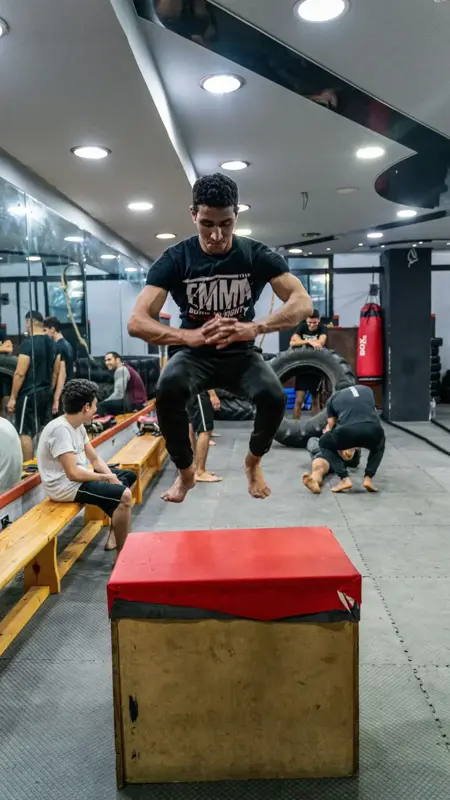
Strength is how much force you can make. Power is how fast you can make it. Fighters need both, but power is what turns into a sharp punch or an explosive shot. That's why fighter programs include jumps, box jumps, medicine ball throws and kettlebell swings alongside heavier lifts.
2. Full-body, ground-up movement
A punch starts from your feet and travels through your hips and core. Training should reflect that: squats, deadlift patterns, lunges, presses, pulls and rotational work, rather than one muscle at a time.
3. Strength endurance and conditioning
Fights are a series of hard bursts with short rest. Fighter conditioning often copies that pattern: circuits or intervals in rounds, with work and rest periods similar to a bout. The aim is to recover quickly and keep your output high when you're tired.
4. Core and stability
Not just crunches. A fighter's core needs to resist rotation, transfer force and protect the body under impact. Planks, carries, anti-rotation work and rotational throws usually do more than endless sit-ups.
5. Durability: neck, shoulders, knees
Fighters take more stress on certain joints. Smart programs add work for the neck, upper back, shoulders, hips and knees to help the body handle that load. It won't make you injury-proof, but it helps.
6. Mobility
Kicks, sprawls and guard work all need range of motion. Getting strong but stiff is a bad trade for a fighter.
Common mistakes fighters make in the gym
- Training like a bodybuilder. Lots of volume and soreness that leaves you flat for sparring.
- Doing only cardio. Running is useful, but without strength work you lose power and durability.
- Going to failure all the time. Fighters usually benefit from leaving a rep or two in the tank so they can still train skill.
- Ignoring recovery. Sleep, food and rest days are part of the program, not extras.
- Copying a pro's routine. A professional's schedule is built for their body and their fight date, not your week.
How much strength training does a fighter need?
For most people who train martial arts a few times a week, around two strength and conditioning sessions per week is a common and sensible starting point. The exact number depends on how many technique classes you take, your experience and how well you recover. Quality beats quantity: two focused sessions are usually better than four tired ones.
Athletic Fitness at EMMA Club
At our Kafr Abdo branch in Alexandria, the Athletic Fitness class is built exactly for this: strength, power and conditioning that carries over to combat sports. It's coached by Amir Elsayed, EMMA's founder and head coach, who has been coaching MMA since 2011 and leading boxing and kickboxing for more than ten years. So the class is designed by someone who knows what fighters actually need, not a generic gym template.
Athletic Fitness runs at Kafr Abdo on Sunday, Tuesday and Thursday from 7:30 PM to 8:30 PM. It sits nicely next to other classes on the same nights, such as Boxing Mix (6:30 PM) or MMA (8:00 PM). See the full timetable for details.
You don't have to be a fighter to join. If you simply want to get fitter and stronger in a way that's athletic rather than just aesthetic, the class works for you too.
If you want to combine Athletic Fitness with fight classes, the VIP unlimited membership covers every program at that branch. Prices are on our membership page.
A simple weekly example
Just to show how it can fit together (adjust to your level and schedule):
- Sunday: Athletic Fitness + a technique class
- Tuesday: Athletic Fitness + a technique class
- Thursday: technique class, lighter or no strength work if you're sparring
- Other days: rest, walking, mobility
If you have an injury or a medical condition, check with a doctor before starting a new program and tell your coach so the session can be adjusted.
FAQ
Will lifting weights make me slow for fighting?
Not if it's done right. Explosive, full-body training usually makes fighters faster and more powerful. Slowness tends to come from heavy bodybuilding-style volume and poor recovery.
Do I need to lift heavy?
Some heavy work helps, but you don't need to chase max lifts. Moderate loads moved with good technique and speed, plus conditioning, cover most of what a fighter needs.
Can beginners join Athletic Fitness?
Yes. The coach scales exercises and loads to your level, so you can start where you are.
Is Athletic Fitness available at the Roshdy branch?
Currently it runs at the Kafr Abdo branch only, Sunday, Tuesday and Thursday, 7:30 PM to 8:30 PM.
Want to feel the difference between a regular gym session and training like a fighter? Your first class at EMMA Club is free. Book your free class and try Athletic Fitness at Kafr Abdo.