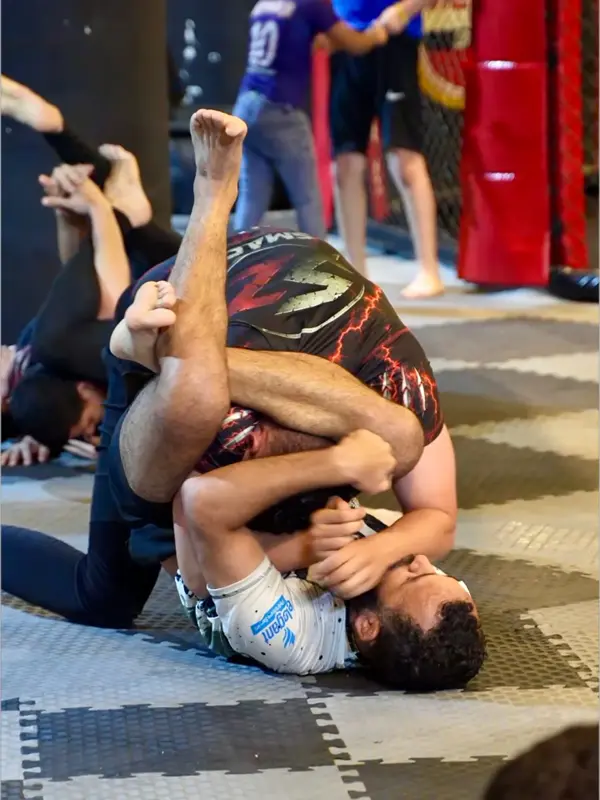
For most people, a Brazilian Jiu-Jitsu blue belt takes somewhere around 1.5 to 3 years of consistent training. Someone who trains three or more times a week might get there toward the faster end; someone training once a week will usually take longer. There is no fixed date. Your coach promotes you when your skills on the mat show you are ready.
Here is what actually drives that timeline, and how to make the most of your white-belt years.
The adult BJJ belt system in brief
The adult belt ranks go white, blue, purple, brown and black. Under the guidelines of the IBJJF (International Brazilian Jiu-Jitsu Federation), the main sport governing body, there is no minimum time at white belt before blue. Minimum times only start to apply from blue belt upward, and the IBJJF sets a minimum age of 16 for an adult blue belt.
In practice, though, each academy and coach decides promotions. The federation guidelines set a floor; the coach decides when you are actually ready.
What is a stripe?
Most academies award up to four stripes on each belt before the next promotion. A stripe is a small tape mark on the black bar of your belt. It shows you are progressing within that belt.
Stripes are not standardised. Some coaches award them regularly, some rarely, and some do not use them at all. Do not treat them as a countdown. Four stripes does not automatically mean blue belt next week.
What decides how fast you progress?
1. How often you train
This is the biggest factor by far. Mat time is everything in BJJ. Two people who started on the same day can be a year apart if one trains three times a week and the other once.
2. How consistently you train
Three months on, two months off, three months on again is much slower than steady attendance. Your skills fade when you stop, and you spend time catching up.
3. How you train
Paying attention in technique, asking questions, and drilling with intent all speed things up. So does rolling with a goal ("today I work on escaping side control") instead of just surviving.
4. Your background
People with a wrestling or judo background often move faster at first because they already understand balance, grips and pressure. Complete beginners are not at a disadvantage long term, just a slower start.
5. Your coach's standards
Some academies are known for being strict with blue belts. That is not a bad thing. A blue belt from a demanding coach usually means something.
What coaches usually look for in a blue belt
Every coach has their own standard, but common expectations include:
- Solid escapes from bad positions like mount, side control and back control.
- Understanding the main positions and how to move between them.
- A working guard, so you are not just flattened when someone passes.
- A few reliable submissions and the basics of setting them up.
- Takedowns or ways to bring the fight to the ground safely.
- Being a good training partner: safe, controlled, tapping early and letting go when your partner taps.
Blue belt is often described as the point where you can defend yourself well against an untrained person and hold your own with newer students. It is not about winning every roll against other white belts.
Common mistakes that slow people down
- Only rolling to win. Avoiding positions you are weak in means you never improve them.
- Skipping technique. Rolling is fun, but technique is where new skills come from.
- Training through injuries. A small injury ignored can become months off the mats.
- Comparing yourself to others. Everyone's timeline is different.
- Chasing the belt. Ironically, people who stop thinking about the belt often get it sooner.
Training BJJ at EMMA Club in Alexandria
Our Brazilian Jiu-Jitsu program is led by Coach Belal Salah, a BJJ black belt and certified coach and referee with the Egyptian Jiu-Jitsu Federation. He has competed since 2012 and consistently finishes in the top four. You can read more about him on our coaches page.
BJJ classes run at the Kafr Abdo branch (25 Mina Street, Sidi Gaber) on Sunday and Tuesday from 9:30 to 10:30 PM. Coach Belal also leads the self-defense classes at the same branch on Thursday and Friday.
If you want more mat time to speed up your progress, the VIP unlimited plan at Kafr Abdo covers every program at that branch, so you can add wrestling or MMA alongside BJJ. Wrestling in particular helps with takedowns and top pressure. Prices are on the membership page, and the full schedule is on the timetable.
FAQ
Can you get a BJJ blue belt in one year?
It happens, usually with very frequent training or a strong grappling background. For most people it takes longer, and that is completely normal.
Do you have to compete to get promoted?
Usually not. Competition can help you learn, but most coaches promote based on what they see in class.
Is there a minimum age for a blue belt?
Under IBJJF guidelines, the adult blue belt has a minimum age of 16. Younger students use a separate youth belt system.
How many classes a week should I train?
Two to three a week is a good, sustainable target for most adults. Consistency over months matters more than any single week.
Every blue belt started with one class. Book your free first BJJ class at our Kafr Abdo branch and start your white-belt journey.