There's no single "best" martial art for self-defense, but the most effective ones have one thing in common: you practice against a resisting partner. Boxing, Muay Thai, wrestling, Brazilian Jiu-Jitsu and MMA all do this, and each covers a different part of a real confrontation. And the most important self-defense skill isn't a technique at all: it's avoiding the fight in the first place.
Here's an honest look at what each one gives you, and what it doesn't.
Avoidance comes first
Before comparing styles, it's worth being clear about what self-defense actually means. The goal isn't to win a fight. It's to get home safe. In practice, that usually means:
- Awareness: noticing trouble early, and not being distracted by your phone in risky places.
- Distance: keeping space between you and a threat.
- De-escalation: calm words, open hands, no ego.
- Leaving: walking or running away is almost always the best outcome.
- Giving up property: a phone or wallet is never worth getting hurt over.
Physical skills are for when none of that works. And real situations can involve weapons or more than one attacker, which changes everything. No martial art makes you invincible.
What makes a martial art work for self-defense?
Look for three things:
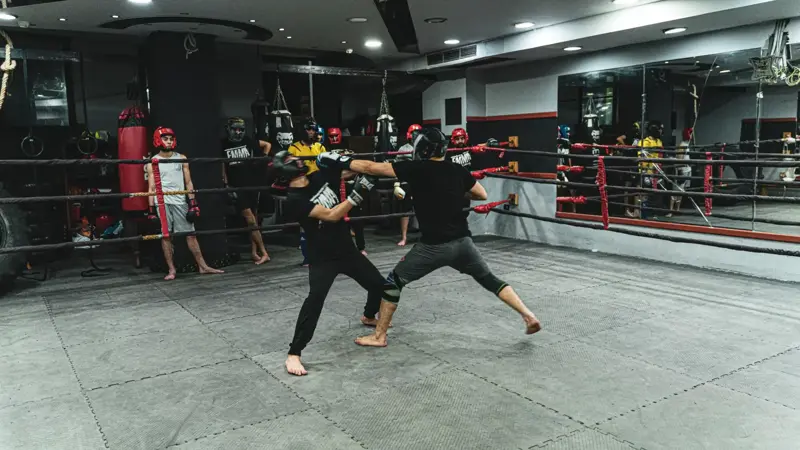
- Live training (sparring). If you never practice against someone actually resisting, you won't know if your techniques work under stress.
- Simple, repeatable techniques. Under adrenaline, fine motor skills drop. Simple moves trained many times hold up best.
- Fitness. A short burst of struggle is exhausting. Being fit gives you a big advantage, including the ability to run.
Honest comparison
Boxing
Strengths: fast to learn the basics, excellent hand speed, footwork and head movement. You get used to being hit and staying calm, which matters a lot.
Gaps: no kicks, no clinch work beyond the basics, and nothing for the ground.
Muay Thai
Strengths: uses fists, elbows, knees and kicks, plus a strong clinch. Very effective at close range and builds serious toughness.
Gaps: little ground work. High kicks look great but are risky in street clothes or on bad ground.
Wrestling
Strengths: balance, takedown defense and the ability to stay on your feet. In a real situation, not going to the ground is a big deal. Wrestlers are also usually very strong and fit.
Gaps: no striking, and some takedowns are risky on concrete.
Brazilian Jiu-Jitsu (BJJ)
Strengths: the best tool if you end up on the ground, which happens often in real fights. It teaches you to escape bad positions and control someone bigger with technique, without needing to strike. Very useful for smaller people.
Gaps: sport BJJ sometimes encourages pulling guard or ignoring strikes, which is a bad idea in a real fight, especially against multiple people.
MMA
Strengths: combines striking, wrestling and ground work, so it covers the most ground. You learn how the ranges connect: standing, clinch and ground.
Gaps: it takes longer to become competent in everything, and it's still a sport with rules.
| Style | Standing | Clinch | Ground | Time to basic competence |
|---|---|---|---|---|
| Boxing | Strong (hands) | Limited | None | Relatively fast |
| Muay Thai | Strong | Strong | None | Moderate |
| Wrestling | Takedowns/defense | Strong | Control | Moderate |
| BJJ | Limited | Some | Strong | Moderate to slow |
| MMA | Good | Good | Good | Slower (more to learn) |
So which should you pick?
If you want the most complete answer, MMA or a mix of a striking art plus BJJ or wrestling covers the most situations. If you want something quick and practical, boxing gives you useful skills fast. If you're smaller and worried about being overpowered, BJJ is especially valuable.
The honest truth: the best martial art for you is the one you'll actually keep training. Six months of consistent, live training in any of these beats a year of collecting techniques you never pressure-test.
What a dedicated self-defense class adds
Combat sports are great, but they have rules. A focused self-defense class fills the gaps: escaping grabs and holds, getting up safely from the ground, protecting your head, creating space to escape, and thinking about situations rather than rounds.
At EMMA Club in Alexandria, our Self-Defense class is led by Coach Belal Salah, a Brazilian Jiu-Jitsu black belt and certified coach and referee with the Egyptian Jiu-Jitsu Federation, who has competed since 2012. That grappling background matters, because so many real confrontations end up in grabs, clinches or on the ground.
The class runs at our Kafr Abdo branch on Thursday from 9:30 PM to 10:30 PM and Friday from 8:00 PM to 10:00 PM. You can also build your skills in our MMA, boxing, Muay Thai, wrestling and BJJ programs. See the full timetable, and our membership page for prices, including VIP unlimited access to every program at a branch.
FAQ
Is BJJ or Muay Thai better for self-defense?
They solve different problems. Muay Thai is strong standing and in the clinch; BJJ is strong on the ground. Ideally, learn some of both.
How long does it take to learn self-defense?
You can learn useful basics in a few weeks, but real confidence under pressure usually takes months of consistent training with live practice.
Do I need to be fit to start?
No. You'll get fitter as you train. If you have an injury or medical condition, check with a doctor first and tell your coach.
Can women join the self-defense class?
Yes, the class is open to everyone. Women who prefer a women-only setting can also try Female Kickboxing with Coach Salma at our Roshdy branch.
The best way to find out what works for you is to try it. Your first class at EMMA Club is free. Book your free class and come train with Coach Belal at Kafr Abdo.
Women-only kickboxing in Alexandria: EMMA runs a women-only class with female coach Salma Tarek at the Roshdy branch (Deebmall) — Saturday, Monday and Wednesday, 6:30–7:30 PM. Your first class is free.