
The short answer: Muay Thai uses eight weapons (fists, elbows, knees and shins) plus a long standing clinch, while most kickboxing rule sets allow only punches and kicks, with little or no clinching. That one difference changes the stance, the pace, the scoring and how a class feels. Both are excellent, and at EMMA Club in Alexandria you can train either one.
If you are trying to choose between them, this guide breaks down what actually differs on the mats, not just on paper.
The quick comparison
| Muay Thai | Kickboxing (most rule sets) | |
|---|---|---|
| Strikes allowed | Punches, kicks, knees, elbows | Punches and kicks; knees sometimes, elbows rarely |
| Clinch | Central part of the sport | Limited or broken up quickly |
| Stance | More upright, square, weight often on the back leg | Lower and more bladed, closer to a boxing stance |
| Rhythm | Often slower start, building over rounds | Usually busier, faster combinations from the bell |
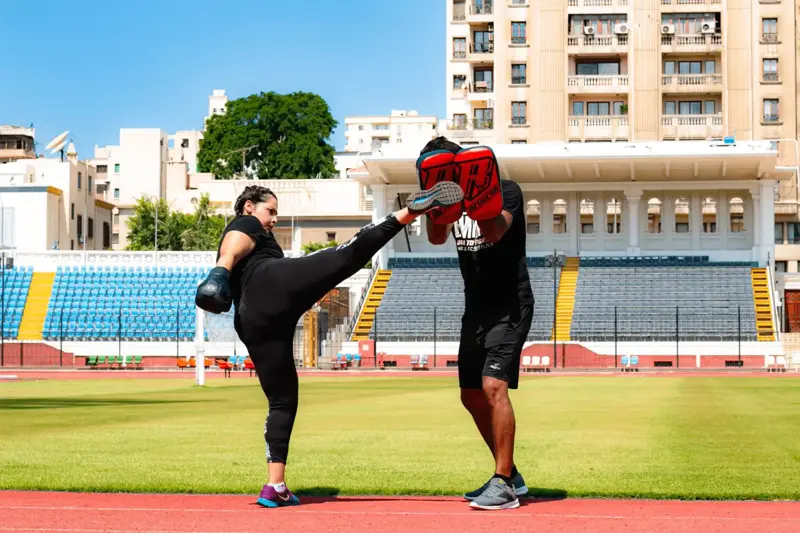
| Kicks | Heavy round kicks with the shin, lots of checking | Mix of shin and foot, often faster and set up with hands |
Elbows and knees: the "art of eight limbs"
Muay Thai is often called the art of eight limbs because it counts two fists, two elbows, two knees and two shins as weapons. Elbows are short-range strikes that can cut and end exchanges quickly. Knees come from range, from a step, or from inside the clinch.
In kickboxing, the toolset is usually narrower. Many competitions allow knees but not elbows, and some amateur formats restrict knees too. The result is a style that leans more on hand combinations finished with a kick.
For a beginner this matters less than you might think. You will not be throwing elbows at anyone in week one. In a Muay Thai class you will simply learn more tools over time, and you will learn how to defend against them.
The clinch
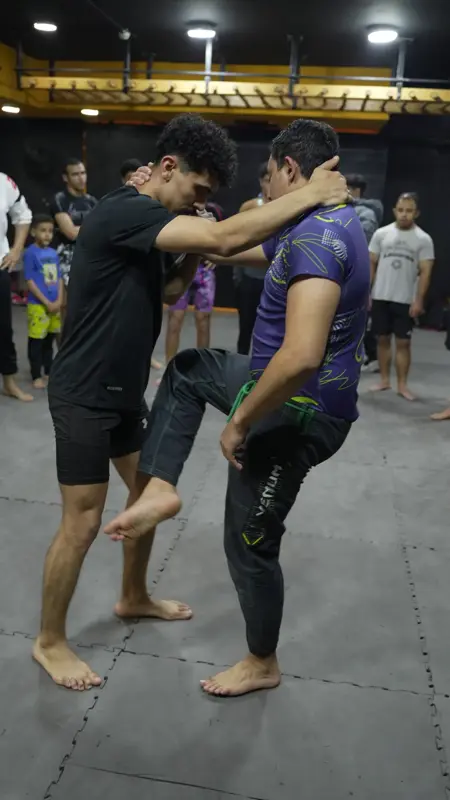
This is the biggest practical difference. In Muay Thai, when two fighters tie up at close range, the referee usually lets them work. Fighters control the head and arms, off-balance each other, and land knees. Clinch work is its own skill, and it takes time to get comfortable with it.
In most kickboxing rules, clinching is limited to a brief hold or a single knee, and the referee separates fighters quickly. That keeps the action at punching and kicking range.
If you like close-range, grinding, physical exchanges, the clinch is a reason to pick Muay Thai. If you prefer to stay at range and move, kickboxing may suit you better.
Stance and footwork
Muay Thai fighters tend to stand taller and more square, with the lead leg light so they can check (block) low kicks with the shin and throw quick teeps (push kicks). Because they expect kicks and knees from every angle, they keep their hips facing forward more.
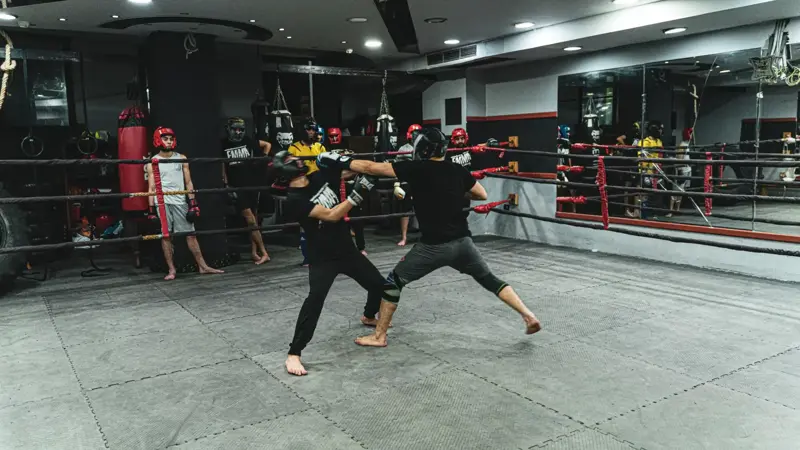
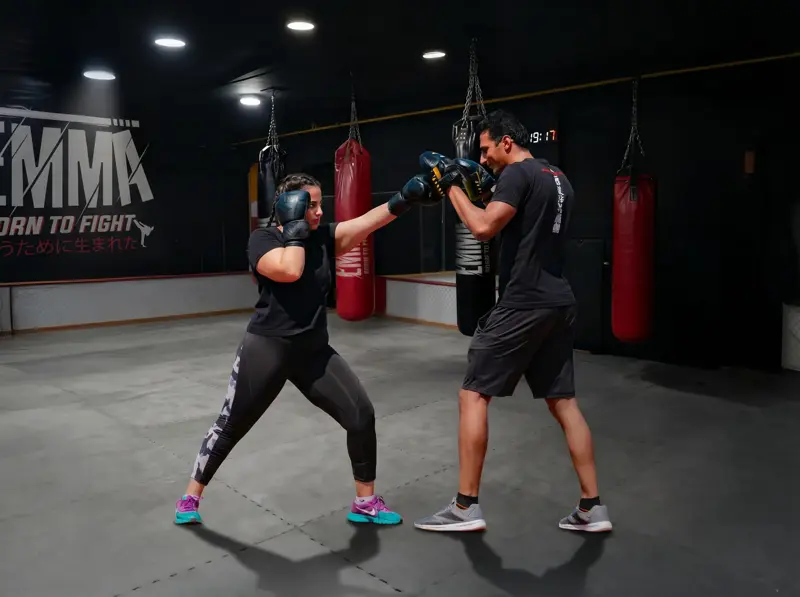
Kickboxers usually stand lower and more side-on, a bit like boxers. Footwork is lighter and more about angles and getting in and out. Punches tend to be a bigger share of the output.
Scoring and pace
Traditional Muay Thai scoring rewards clean, powerful strikes that visibly affect the opponent, balance and control in the clinch, and the overall picture of who is dominating. Kicks to the body and clean knees often score well. The pace can start measured and build as the fight goes on.
Kickboxing scoring generally rewards volume and effective aggression more evenly across rounds. That is one reason kickboxing often looks faster from the first bell.
Rules vary by organisation, so take this as a general picture rather than a rulebook.
Which one is better for you?
Neither is "better". They suit different goals and personalities:
- Pick Muay Thai if you want a complete stand-up system, enjoy close-range work, and like the idea of learning the clinch, knees and elbows.
- Pick kickboxing if you want fast combinations, a strong fitness focus, and a style that stays mostly at punching and kicking range.
- Planning to try MMA later? Both transfer well. Muay Thai's clinch and knees carry over directly, and kickboxing's hand-kick combinations are very useful too.
How EMMA Club runs both in Alexandria
EMMA Club has two branches, and each style lives at a different one.
Muay Thai at the Roshdy branch
Muay Thai runs at our Roshdy branch (1 Syria Street, Deebmall) on Saturday, Monday and Wednesday from 5:30 to 6:30 PM. It is led by Coach Mohamed Bedewy, who has 25 years of Muay Thai experience across Egypt and Lebanon and is a certified coach with the Egyptian Muay Thai Federation.
Kickboxing Mix at the Kafr Abdo branch
Kickboxing Mix runs at our Kafr Abdo branch (25 Mina Street, Sidi Gaber) on Sunday, Tuesday and Thursday from 5:30 to 6:30 PM with Coach Souhaib, who has been coaching since 2014 and blends kickboxing with strength-and-conditioning work.
Women who prefer a women-only class can also look at Female Kickboxing at Roshdy with Coach Salma Tarek. You can see every class on the timetable.
Each branch has its own membership. If you want to train more than one program at the same branch, the VIP unlimited plan covers all programs at that branch. Full prices are on the membership page.
FAQ
Is Muay Thai harder than kickboxing?
Not harder, just broader. Muay Thai adds elbows, knees and the clinch, so there is more to learn. Kickboxing is usually faster-paced. Both are beginner-friendly when the coaching is structured.
Which is better for self-defense?
Both give you real striking skills. Muay Thai's clinch and knees are useful at close range, which is where many real situations happen. Neither replaces awareness and avoiding trouble in the first place.
Can I train both at EMMA Club?
Yes, but they run at different branches: Muay Thai at Roshdy and Kickboxing Mix at Kafr Abdo. Each branch has its own membership.
Do I need gear for my first class?
Comfortable sportswear and water are enough to start. Ask the coach on your first visit what gear to get as you continue.
Still not sure which suits you? Try one before you decide. Your first class at EMMA Club is free at either branch, and the coach will help you figure out where you fit.